There are few things more unsettling than walking into your yard and spotting something that looks like it crawled out of a sci-fi movie.
You’re expecting leaves, maybe a pinecone, maybe some fallen fruit.
Instead, you see:
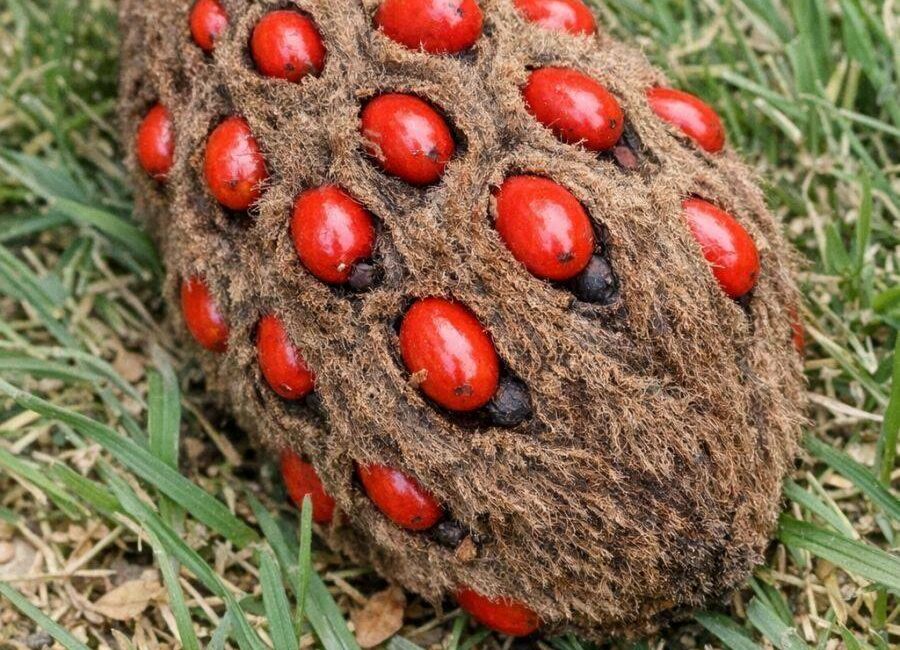
A dense, fuzzy, cone-shaped structure.
Bright red berry-like beads protruding from it.
A texture that looks half plant, half creature.
A shape that resembles a tiny grenade.
Your brain immediately runs through options:
- Is it dangerous?
- Is it toxic?
- Is it some kind of fungus?
- Did something lay eggs here?
- Should I touch it?
And most importantly:
What is this thing?
Let’s walk through this mystery slowly, scientifically, and thoroughly — because what looks alien is almost always a masterpiece of natural design.
Part I: The Immediate Reaction — Why It Looks So Unnatural
Humans are wired to react strongly to unfamiliar biological forms. This is called neophobia — the fear of new or strange things.
When you see something fuzzy, cone-shaped, and studded with bright red protrusions, your mind flags it as:
- Potentially toxic
- Potentially parasitic
- Potentially invasive
Bright red in nature is rarely subtle. It signals:
- Warning
- Attraction
- Toxicity
- Ripeness
- Reproduction
And fuzziness adds to the mystery.
Fuzzy textures in plants usually mean:
- Protection
- Immature growth
- Fungal colonization
- Insect involvement
So your brain sees:
“Unusual shape + warning color + unfamiliar texture.”
It feels alien.
But almost certainly, it is not.
Part II: The Most Likely Culprit — Staghorn Sumac
Based on your description — fuzzy cone with bright red berry clusters — the strongest candidate is:
Staghorn Sumac (Rhus typhina)
This plant is common across North America and parts of Europe and Asia.
And it produces something that perfectly matches your description.
What Staghorn Sumac Looks Like
The plant forms:
- Upright cone-shaped clusters
- Densely packed tiny red fruits
- A fuzzy or velvety surface
- A texture that looks almost synthetic
From a distance, it resembles:
- A torch
- A fuzzy grenade
- A pinecone dipped in red velvet
If it has fallen from a tree or shrub and landed under your tree, that’s entirely normal.
Sumac often sheds fruit clusters after maturity or during storms.
Part III: Why Is It Fuzzy?
The fuzz isn’t random.
Each tiny red fruit is covered in small hairs.
Those hairs serve important biological purposes:
- Protection from insects
- Moisture regulation
- Temperature insulation
- Bird attraction through texture contrast
The fuzz makes the cluster more resilient to:
- Rain
- Cold
- UV radiation
- Predators
It also increases surface area, which enhances scent dispersal and visual texture for birds.
Part IV: Why Bright Red?
Bright red is evolutionary advertising.
Birds see red exceptionally well.
Many birds are attracted specifically to red fruits because:
- Red contrasts strongly against green foliage.
- It signals ripeness.
- It’s visible from long distances.
The plant benefits because:
Birds eat the berries →
Seeds pass through digestive system →
Seeds get deposited elsewhere →
New plants grow.
The plant doesn’t want you to eat it.
It wants birds to eat it.
Part V: Is It Dangerous?
Here’s where we separate fear from fact.
Staghorn sumac berries are not highly toxic.
In fact:
- Some species of sumac are used to make beverages (sumac tea).
- The berries have a tart, lemon-like flavor.
However:
- Some people confuse sumac with poison sumac (which looks very different).
- You should never consume unknown berries without proper identification.
If you’re unsure, don’t taste it.
But visually? It’s almost certainly harmless.
Part VI: Other Possible Candidates
If it’s not sumac, there are other intriguing possibilities.
Coralberry (Symphoricarpos)
Coralberry produces:
- Dense red or pink berries
- Tight clusters
- Smooth but sometimes slightly textured fruit
However, coralberries are usually more spherical and less cone-shaped.
They are mildly toxic to humans but not dangerously so.
Red Slime Mold or Fungal Growth
Sometimes what looks like berries isn’t fruit at all.
Certain fungi and slime molds produce:
- Bright red clustered growths
- Fuzzy textures
- Alien-like formations
These usually grow directly from:
- Decaying wood
- Leaf litter
- Damp soil
They are rarely dangerous unless ingested.
Pine or Fir Cone with Fungal Colonization
Clique sur page 2 pour suivre