Sometimes a regular pinecone becomes:
- Colonized by mold
- Infested with scale insects
- Covered in sap and debris
Which can give it a bizarre appearance.
But pinecones usually don’t produce berry-like structures.
Part VII: Why It Ended Up Under Your Tree
Several mechanisms could explain its location:
- Natural drop from nearby shrub
- Bird dropped it while feeding
- Wind carried it
- Squirrel activity
- Seasonal fruit shedding
Autumn is peak time for discovering these clusters.
Plants release seeds before winter to prepare for spring germination.
Part VIII: Ecological Importance
That strange fuzzy cone is not just decoration.
It serves multiple ecological roles:
- Winter food for birds
- Shelter for insects
- Microhabitat for fungi
- Soil nutrient recycling
Even when it decays, it contributes:
Organic matter → soil fertility → microbial life.
What looks like garden debris is actually ecosystem infrastructure.
Part IX: Cultural Significance of Red Berries
Red berry clusters appear frequently in folklore.
They symbolize:
- Protection
- Survival in winter
- Vitality
- Warning
- Transition between seasons
In many cultures, red berries were used in:
- Winter rituals
- Medicinal preparations
- Natural dyes
Humans have long associated red fruits with both danger and sustenance.
Part X: The Psychology of “Alien” Nature
Why do we label it alien?
Because it violates expectations.
We expect:
- Smooth fruit
- Green leaves
- Brown pinecones
We don’t expect:
- Fuzzy cones
- Neon red clusters
- Textures that look synthetic
But nature routinely produces forms stranger than science fiction.
We just don’t notice them often.
Part XI: Safety Checklist
If you encounter something like this:
- Do not ingest
- Wear gloves if handling
- Keep pets from chewing
- Photograph before moving
- Use identification apps
- Check regional plant guides
Caution without panic is ideal.
Part XII: How to Confirm Identification
Take photos showing:
- Entire cluster
- Close-up texture
- Nearby leaves
- Tree bark
- Surrounding environment
Upload to:
- iNaturalist
- PlantNet
- Local extension services
Experts can often identify it within hours.
Part XIII: Should You Remove It?
If it’s sumac or coralberry:
You can leave it.
If it’s fungal growth:
It will naturally decompose.
If it’s invasive species:
Consult local extension office.
But in most cases:
It’s harmless and ecologically beneficial.
Part XIV: Gardening Perspective
Garden literacy includes learning to distinguish:
- Fruit vs fungus
- Seed cluster vs disease
- Natural drop vs infestation
The more you observe your yard, the less alien it feels.
What once looked like a grenade becomes:
“Ah, sumac fruiting body.”
That’s growth in knowledge.
Part XV: The Bigger Lesson
Moments like this reveal something deeper:
Nature is complex.
Perception is limited.
Curiosity beats fear.
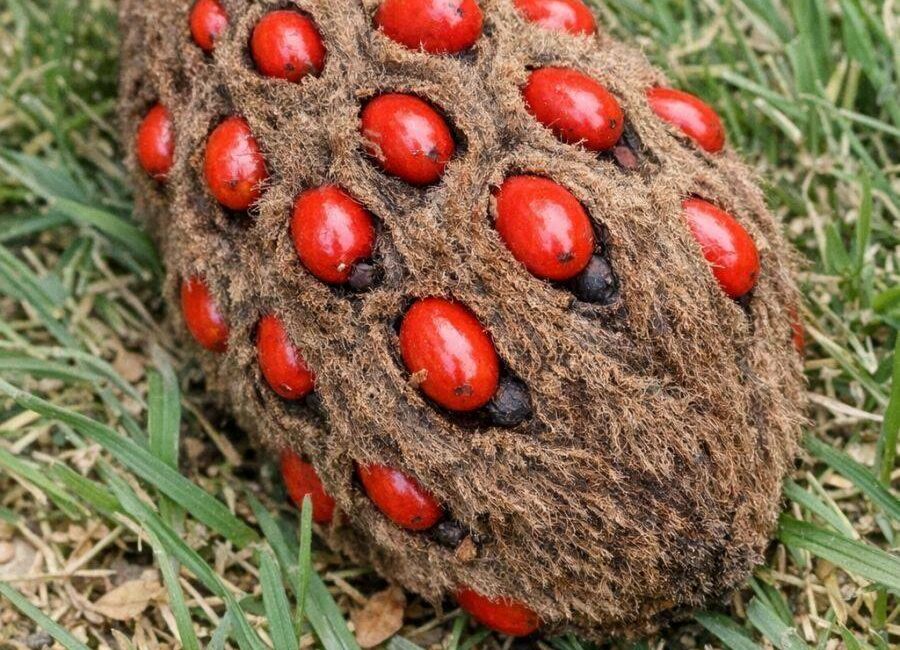
The fuzzy red cone under your tree is not an alien.
It’s not a weapon.
It’s not a parasite from space.
It is almost certainly a reproductive structure — a plant investing energy into survival.
And that, in itself, is beautiful.
Final Likely Answer
Based on your description:
The most probable identity is Staghorn Sumac fruit cluster.
It matches:
- Fuzzy texture
- Cone shape
- Bright red coloration
- Common occurrence under trees
It may look extraterrestrial.
But it’s entirely terrestrial.
And now you know.
Nature just disguised it wel